
Why Church Small Groups Could Be the Missing Piece in Your Faith Journey
Church small groups are intentional gatherings of believers — typically 8 to 15 people — who meet regularly to study Scripture, pray together, and support one another in daily life.
Here is a quick overview of what you need to know:
| Question | Quick Answer |
|---|---|
| What are they? | Small, regular gatherings of believers for Bible study, prayer, and community |
| Biblical basis | Rooted in Acts 2:42 — early Christians met in homes to learn, fellowship, and pray |
| Why join? | Spiritual growth, accountability, genuine friendship, and transformation |
| Who are they for? | Anyone seeking deeper connection beyond a Sunday morning service |
| How big? | Typically 8–15 people — small enough to truly know one another |
If you have ever sat in a church service surrounded by hundreds of people and still walked out feeling completely alone, you are not the only one. That feeling of disconnection is one of the most common struggles in modern church life — and it is exactly the gap that small groups are designed to close.
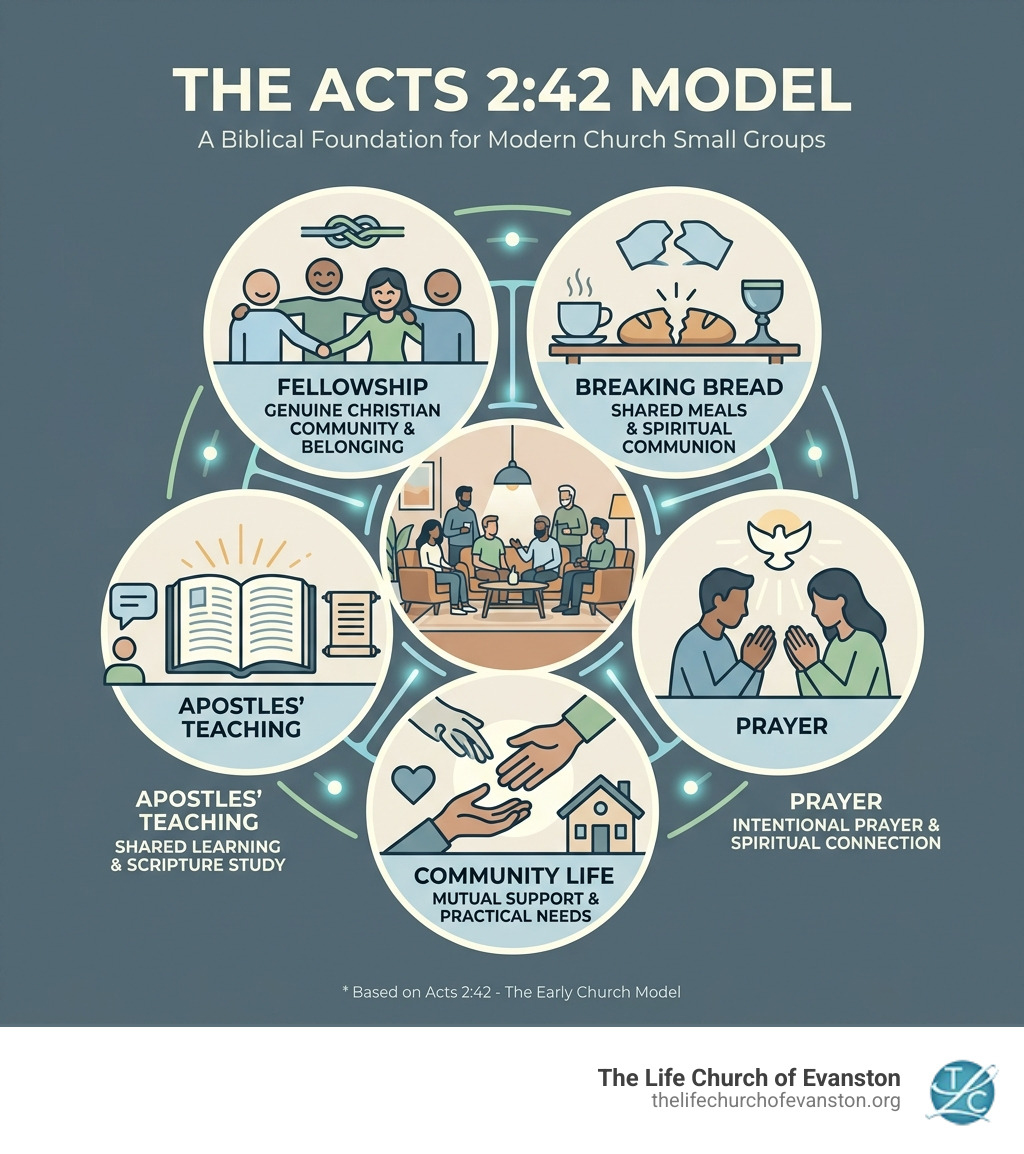
The early church understood this well. After Pentecost, thousands came to faith in a single day (Acts 2:41). There was no building large enough to hold them all in one intimate setting. So they did something beautifully simple — they met in homes. They shared meals, prayed together, learned the apostles’ teaching, and looked after one another’s needs (Acts 2:42-46). That model was not just practical. It was transformational.
Nearly 8 in 10 churchgoers today still agree that small groups are very important to the life of a healthy church. And yet, many believers have never experienced the depth of community that a well-led small group can provide.
I’m Anthony LoCascio, pastor of The Life Church of Evanston, and I have spent years building and leading church small groups that move people from spiritual isolation into genuine, Spirit-filled community. In this guide, I want to walk you through everything — from the biblical foundation to practical steps for finding or leading a group that actually changes lives.
What Are Church Small Groups?
At its core, a church small group is the “small” within the “big.” While corporate worship on Sundays is vital for praising Jesus Christ with one voice, Church small groups provide the space where the “one-anothers” of Scripture actually happen. In Acts 2:46, we see the early believers continuing daily with one accord in the temple, and breaking bread from house to house.

This “house to house” ministry is where koinonia—biblical fellowship—truly flourishes. It is more than just a social club or a hobby group; it is a spiritual family. In these settings, we move beyond being faces in a crowd to being brothers and sisters who know each other’s names, burdens, and joys. As highlighted in How to Make a Small Group that Actually Works, an effective group is one that aligns with the church’s mission to make disciples, ensuring that the time spent together results in real spiritual progress.
Defining the Life Group Model
At The Life Church of Evanston, we call our Church small groups Life Groups. We believe that life is better together. Our model is built on being Spirit-led and transformation-focused.
A typical Life Group consists of 8 to 15 members. This size is intentional. It is large enough to offer diverse perspectives and support, but small enough that no one gets lost in the shuffle. We utilize “relational on-ramps”—simple, welcoming ways for newcomers to join in—ensuring that our multicultural environment feels like home from the very first visit. Whether you are in Evanston or the North Shore, these groups serve as the primary place for discipleship and care.
The Difference Between Information and Transformation
One of the biggest pitfalls in Church small groups is settling for mere information. It is easy to sit in a circle, read a book, and learn new facts about the Bible. However, information alone does not change a life.
True transformation happens when the Holy Spirit takes the Word of God and applies it to the heart. This requires life application and, at times, a level of biblical counseling where we help one another navigate trials. Instead of just asking, “What did this verse say?” we ask, “How does this verse change the way I treat my spouse or handle my anxiety this week?” We are looking for heart change that results in becoming more like Jesus Christ.
The Biblical Foundation for Community
The concept of community isn’t a modern invention; it is rooted in the very nature of God. We see a reflection of the Trinity—Father, Son, and Holy Spirit—in the way we are called to live in relationship. God said in the beginning, “It is not good that the man should be alone” (Genesis 2:18).
Hebrews 10:25 gives us a clear command: “Not forsaking the assembling of ourselves together, as the manner of some is; but exhorting one another: and so much the more, as ye see the day approaching.” This “one-another” ministry is the engine of the church. According to the Small Group Guidelines for Church Ministries, these groups allow us to image God’s relational nature through love, service, and unity.
The Biblical Mandate for Church Small Groups
For those of us in the Pentecostal heritage, we look to the Book of Acts as our blueprint. The Apostolic doctrine was not just preached from a pulpit; it was discussed over dinner tables.
In Acts 2:42, the Bible says they “continued stedfastly in the apostles’ doctrine and fellowship, and in breaking of bread, and in prayers.” This wasn’t a weekly suggestion; it was a daily lifestyle. They were a people of the Spirit who understood that spiritual survival in a difficult world required constant, prayerful connection with other believers. By meeting in Church small groups, we carry on this sacred tradition, keeping the fire of Pentecost alive in our homes.
Following the Example of Jesus and the Twelve
If anyone could have “done ministry” alone, it was Jesus. Yet, He chose twelve men to be with Him. This was the first small group. Jesus didn’t just lecture them; He lived with them. He showed them how to pray, how to serve, and how to reach the lost.
This missional focus is key. A group that only looks inward eventually becomes stagnant. Jesus trained His disciples to have a “kingdom culture” mindset—preparing them for the Great Commission. As we look at biblical prophecy and the current state of the world in 2026, we see that having a close-knit group of Spirit-filled believers is more important than ever for staying grounded in the faith.
Why Small Groups are Vital for Church Health
Research consistently shows that Church small groups are the backbone of a healthy congregation. Statistics indicate that 79% of churchgoers view small groups as “very important.” While many churches struggle with low engagement, a healthy goal is to have 70% of the congregation involved in a small group.
When people are plugged into a group, church growth becomes sustainable. Why? Because people don’t just join a church; they join a community. Small groups provide the spiritual accountability and pastoral care that a lead pastor cannot provide to every individual in a growing church.
Overcoming the 150-Person Connection Limit
There is a sociological concept known as Dunbar’s number, which suggests that most people can only maintain stable social relationships with about 150 people. Once a church grows past this size, members often start to complain, “I don’t know everyone anymore.”
At 250 or 400 attendees, it is impossible to be “best friends” with everyone in the sanctuary. Church small groups solve this by making a large church feel small. They ensure that every person is seen, known, and cared for. You might not know all 500 people in the building, but you know the 10 people in your living room, and they know you. This creates a safety net of community strength that prevents people from falling through the cracks.
Moving from Cul-de-Sacs to Thoroughfares
A common pitfall for Church small groups is becoming a “cul-de-sac”—a dead-end street where the same people meet for years, never inviting anyone new, and eventually becoming insular.
We want our groups to be “thoroughfares.” A thoroughfare is a road that leads somewhere. Our groups should be missional, always looking for ways to welcome newcomers and eventually “multiply” by starting new groups. This outward focus is a powerful gospel witness. When a multicultural group of believers in Evanston loves each other and welcomes the stranger, it proves the power of Jesus Christ to unite a divided world.
Practical Steps to Launch and Lead
Starting or leading Church small groups doesn’t require a master’s degree in theology, but it does require a heart for people and a dependence on the Holy Spirit. We recommend a 1:3 coaching ratio—where one experienced leader coaches three newer leaders—to ensure no one feels overwhelmed.
If your church is new to this, try a “trial run.” Launch a few groups for a 6-to-12 week “sprint” using a simple video curriculum. This lowers the barrier to entry and allows people to “taste and see” the benefits of community without a lifetime commitment.
Cultivating a Transformational Environment
To move from a social gathering to a transformational one, leaders must foster a safe space for vulnerability. If the leader is never honest about their struggles, the members won’t be either.
We often talk about the “joy quotient.” On a scale of 1 to 10, how is your joy as you navigate your current trials? Asking probing questions like this moves the conversation deeper. When we share our prayer requests and exercise spiritual gifts—like a word of encouragement or a prayer for healing—we create an environment where the Spirit of God can move freely.
How to Find the Right Church Small Groups for You
Choosing a group can feel daunting, but it starts with prayerful discernment. Think about your current life stage. Are you a young parent looking for a group that integrates with our Kidz4Life program? Are you looking for a group in your specific neighborhood in the North Shore?
We encourage you to:
- Reflect on your needs: Do you need deep Bible study, or are you looking for basic fellowship?
- Check the location: Finding a group near your home makes consistency much easier.
- Try it out: It is okay to visit a couple of groups to find the one where you feel most at home.
Ready to take the next step? You can Join a Life Group today and start experiencing the difference for yourself.
Frequently Asked Questions about Church Small Groups
What happens in a typical small group meeting?
While every group has its own “flavor,” most meetings follow a similar rhythm. We start with fellowship—usually involving food and catching up on each other’s weeks. Then, we move into a time of Scripture study or discussing the recent sermon. We conclude with prayer, sharing burdens, and “ministry activation,” where we pray for one another’s specific needs.
Do I need to be a Bible expert to join or lead?
Absolutely not! All you need is a love for Jesus and a caring heart. For our leaders, we provide the curriculum and training. You don’t have to have all the answers; your job is to facilitate the conversation and remain sensitive to the Holy Spirit’s leading. We believe in Spirit-led facilitation rather than formal lecturing.
How do small groups help me grow closer to Jesus?
Small groups provide the “iron sharpening iron” environment mentioned in Proverbs 27:17. When you are alone, it is easy to stagnate. In a group, you have brothers and sisters who hold you accountable, encourage you when you’re down, and help you apply the Bible to your real-life situations. This communal worship and encouragement are catalysts for rapid spiritual growth.
Conclusion
The Life Church of Evanston is more than just a place to attend a service; it is a family where you can belong. In the heart of Evanston, IL, we are committed to making disciples who experience the transformational power of the Spirit of God. Our multicultural environment is a testament to the fact that Jesus Christ breaks down every wall.
By joining one of our Church small groups, you aren’t just adding another meeting to your calendar—you are opening the door to life-changing relationships and deeper spiritual maturity. We invite you to come and see what God is doing in our midst.
For More info about Life Groups, visit our website or speak with one of our leaders this Sunday. Let’s grow together, serve together, and glorify Jesus Christ together.