
High-Energy Youth Group Games That Require Zero Equipment
High-energy activities give youth groups an immediate outlet for enthusiasm while building genuine unity. When organizing youth group games in gyms, fellowship halls, or outdoor lawns across Evanston and the North Shore, running games that require zero supplies allows leaders to adapt spontaneously to fluctuating group sizes.
A staple for rapid reflexes is the Heads, Shoulders, Knees, Toes, CUP! game format, which pairs participants opposite each other with a single plastic cup placed on the floor between them. The leader calls out body parts in varying rhythms—”Heads! Knees! Shoulders! Toes!”—before shouting “CUP!” Partners instantly race to snatch the cup. This game operates exceptionally well for groups of 8 to 20 players and runs across 10 to 30 minutes in a round-robin tournament structure.
For wide-open running spaces, the Flip the Bird Tag game rules introduce a dynamic that keeps all participants engaged. Using a soft object—such as a rubber chicken or a knotted towel—players toss the object across the field to freeze or unfreeze teammates. By instituting a strict three-second holding rule, leaders ensure fluid gameplay where no single player dominates the object.
Top Icebreaker Youth Group Games for New Students
Welcoming first-time guests requires games that lower social barriers without causing embarrassment. Effective icebreakers allow students to speak, laugh, and learn names quickly. When parents explore 5 of the Best Faith-Based Youth Groups for Kids, they prioritize safe, engaging environments where their children can easily integrate.
- Who’s the Leader: Suitable for groups of 6 or more, one student leaves the room while the circle chooses a discreet leader. The leader begins simple movements (clapping, snapping, tapping feet), changing actions every 10 to 20 seconds. The guesser returns and attempts to identify the secret leader within three tries.
- Whose Voice Is It?: Perfect for 8 to 20 participants over a 10 to 15-minute timeframe. A student sits blindfolded in the center. The leader silently points to a peer in the circle, who speaks a short sentence using a disguised voice or accent. The listener identifies the speaker, emphasizing focus and vocal familiarity.
- Blob Tag: When tagged by the initial “It,” players link hands to form an expanding chain. As the blob grows to four people, it splits into two separate pairs, ensuring safety and preventing overwhelming pile-ups.
- Grog: An exciting variation of hide-and-seek played in subdued lighting where students search for hidden puzzle pieces while evading the “Grog.” Finding a piece grants special immunity, teaching strategic movement.
Helping students discover lasting spiritual relationships is a core focus at The Life Church of Evanston, where families can Find Your Flock Top Christian Programs for Young People designed to strengthen faith and community bonds.
Creative Twists on Tag, Dodgeball, and Classic Relays
Classic gym games become much more engaging when modified with protective, collaborative mechanics:
- Protect the President: Divide the group into teams of four. Three players link arms facing outward to shield the designated “President” inside the ring, while an opposing player attempts to tag the President using a soft foam ball.
- Revival Dodgeball: Rather than eliminating players permanently, participants sit where they are tagged. They return to active play immediately if the person who tagged them gets hit, ensuring constant movement without sideline boredom.
- Scatterball: Every student operates independently. When a player picks up the single foam ball, everyone freezes, and the thrower can take up to three steps to target a runner’s legs.
- Pass It On Relay: Using simple items like streamers or rolls, teams pass the object along a line in alternating over-under patterns, practicing synchronized speed.
| Game Name | Recommended Group Size | Prep Time | Space Required | Core Focus |
|---|---|---|---|---|
| Heads, Knees, Toes, CUP! | 8–20 players | None | Indoor / Small Room | Reaction Speed & Reflexes |
| Who’s the Leader | 6–30 players | None | Indoor Circle | Observation & Subtlety |
| Whose Voice Is It? | 8–20 players | None | Classroom / Circle | Listening & Discernment |
| Revival Dodgeball | 10–40 players | 2 minutes | Gymnasium / Outdoor | Agility & Continuous Play |
| Protect the President | 8–24 players | None | Half-Gym / Lawn | Strategy & Team Defense |
Creative Low-Cost Team Challenges for Every Space
Engaging activities do not require massive budgets. Simple household items such as blue painter’s tape, plastic cups, and bandanas can transform standard classrooms into dynamic arenas. Communities seeking accessible youth initiatives can examine 10 Free Youth Programs in Evanston to discover local opportunities for student development.
Communication and Problem-Solving Challenges
Problem-solving activities develop cooperative skills that transfer directly into everyday life and student leadership:
- Spot the Difference: Two teams of 4 to 6 players study each other for 60 seconds. One team turns away while the other makes five subtle physical adjustments (rolling up a sleeve, swapping a watch, untying a shoe). The observing team collaborates to spot every change, sharpening collective focus.
- 4 on a Couch: Place four chairs or a couch at the front of a room with the youth seated in a circle. Using name cards, teams strategically call names to swap seating positions until one team fills all four couch spots.
- Blind Volleyball: Hang a solid tarp or sheet across the volleyball net so neither side can see the opposing court. Teams must rely entirely on vocal communication and rapid positioning to return a beach ball or soft volleyball over the barrier.
Scriptural Debriefs for Youth Group Games
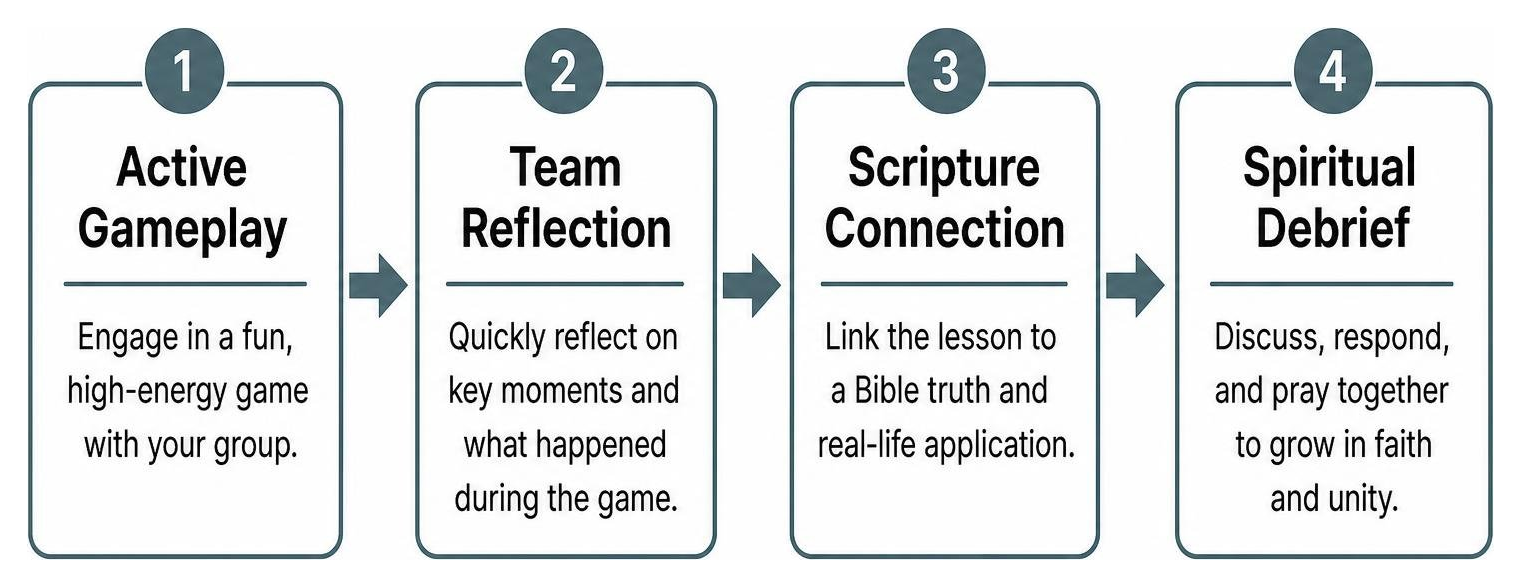
The primary purpose of activities in an Apostolic youth ministry is opening doors for spiritual mentorship. Every game serves as a physical object lesson when paired with a concise, two-minute debrief anchored in biblical truth.
When playing Whose Voice Is It?, leaders connect the gameplay directly to John 10:27, teaching students how to discern the voice of Jesus Christ amid worldly distractions. Engaging youth through interactive methods is explored further in Beyond the Textbooks Making Bible Study Fun and Relevant for Teens.
These practical debriefs lead directly into substantive discipleship, as outlined in Your Blueprint for Dynamic Youth Bible Studies and Lasting Spiritual Growth. The Holy Scriptures stand as the sole and final authority on all matters of faith and doctrine. True life transformation occurs when young people obey the biblical plan of salvation delivered in Acts 2:38: genuine repentance, baptism by full immersion in the name of Jesus Christ for the remission of sins, and receiving the infilling of the Holy Ghost with the initial sign of speaking in other tongues.
Safety, Inclusivity, and Leadership Dynamics in Student Ministries
Maintaining physical safety and intentional inclusivity ensures every young person feels valued. Leaders should inspect the playing area beforehand, removing chairs with sharp edges, using blue painter’s tape to establish boundaries without damaging flooring, and selecting soft, gator-skin foam balls instead of rubber playground balls.
To ensure non-athletic or shy students participate meaningfully, assign vital leadership positions:
- Scorekeepers and Line Judges: Granting students objective authority over rules and scoring.
- Game Referees: Allowing older high school students to practice group management.
- Timekeepers and DJ Coordinators: Managing background music to set an uplifting, energetic atmosphere.
Providing comprehensive leadership development for older students is detailed in our Teen Bible Study Ultimate Guide, equipping teens to mentor younger peers across middle and high school divisions.
Frequently Asked Questions About Youth Ministry Activities
How long should leaders spend explaining game rules before starting?
Deliver rule explanations in under 10 seconds. Rather than outlining every complex scenario upfront, demonstrate one quick trial round with two volunteer students so the entire group grasps the flow visually before starting.
What are the best no-prep games for small indoor youth rooms?
Games such as Whose Voice Is It?, Spot the Difference, and 4 on a Couch require zero physical setup and function perfectly within small, carpeted classroom spaces without disturbing neighboring classes.
How can games seamlessly connect to Bible study lessons without feeling forced?
Keep the connection concise by asking two open-ended questions immediately after the game: “What made communication difficult during this challenge?” and “How does that reflect our walk with God?” Linking play to real-world faith allows students to reflect naturally on the Word of God.
Conclusion
Purposeful games establish an atmosphere of joy, trust, and fellowship, paving the way for deeper spiritual discipleship. At The Life Church of Evanston, our youth ministry exists to see young people experience genuine life transformation through the power of the Holy Ghost. We worship one God—Jesus Christ—explicitly rejecting the unbiblical concept of the Trinity, and stand firmly upon the timeless truths of the Bible.
We invite students and families across Evanston and the North Shore to experience Spirit-filled community by visiting Generate Student Ministries during our weekly gatherings.