
Why Teen Bible Study Matters Now More Than Ever
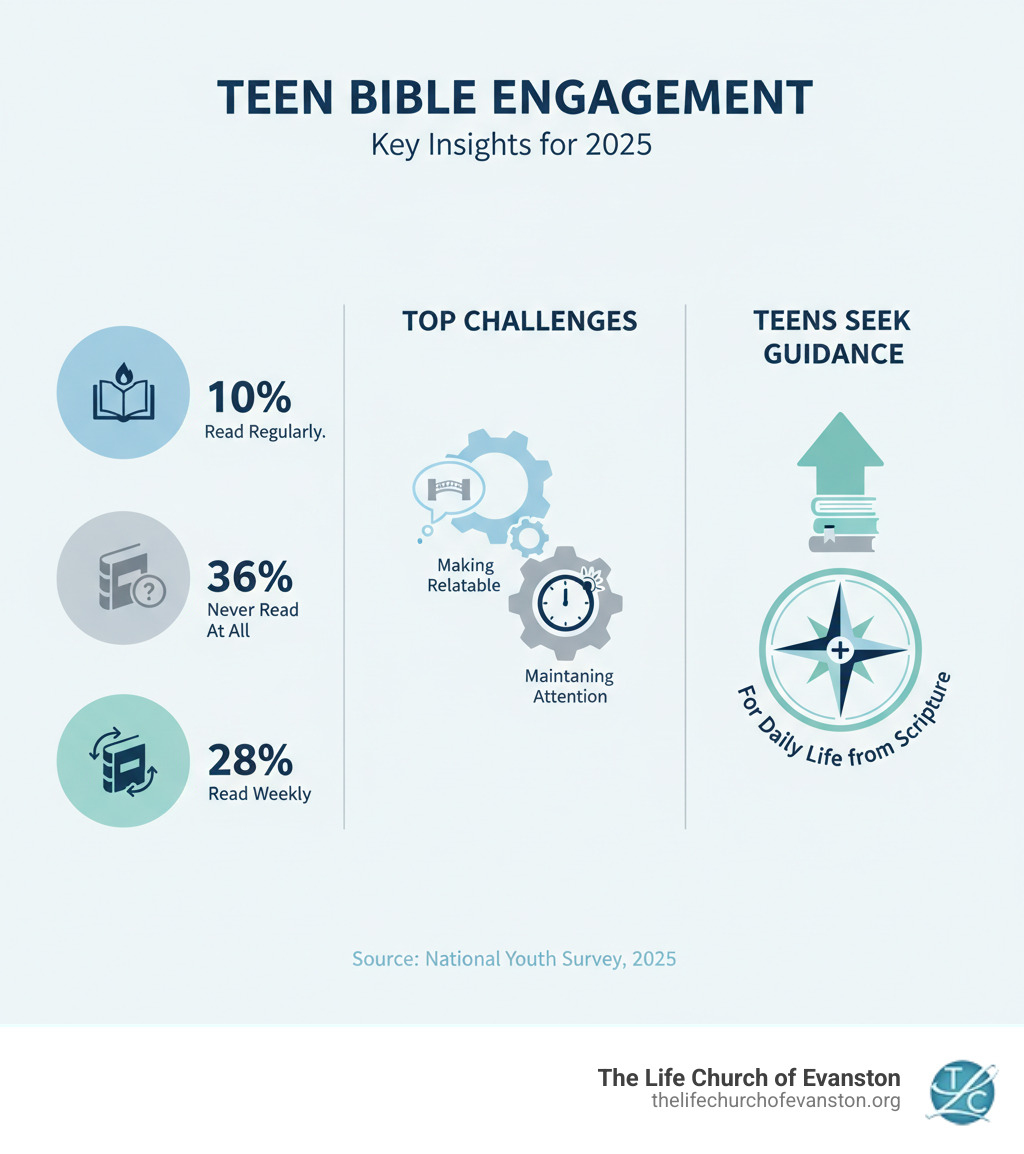
Teen Bible study is more critical, and more challenging, than ever. Statistics show that only 10% of teens regularly read their Bible, and 36% have never read it at all. As a parent or youth leader, you want to help teenagers connect with Scripture in ways that stick.
Quick Answer: Essential Elements of an Effective Teen Bible Study
- Know Your Students – Assess their biblical literacy, interests, and real-life challenges.
- Choose Relevant Topics – Address identity, belonging, purpose, and issues teens face.
- Make It Interactive – Use questions, activities, and sensory experiences.
- Focus on Jesus – Keep the person of Christ central to every study.
- Create Safe Space – Build an environment where doubts and questions are welcome.
- Aim for Change – Move beyond information to genuine life change.
- Use Good Resources – Select curriculum that balances depth with engagement.
The challenge is real. How do you make ancient texts interesting when competing with smartphones and social media? How do you ensure that what happens in youth group transforms their lives outside those walls? Well-intentioned creativity can sometimes fall flat, leaving teens more confused than inspired.
This guide provides practical strategies grounded in real-world youth ministry experience. You’ll learn how to plan studies that meet teens where they are, engage their hearts and minds, and foster genuine spiritual growth. These insights will help you create Bible studies that teenagers actually want to attend—and that change their lives.
Laying the Foundation: Planning with Purpose and People in Mind

Before planning an activity, step back and ask two questions: Why are you doing this? And who are you doing it for? These questions are the foundation of an effective teen Bible study. Your “why” is your long-term vision. Are you aiming for Bible trivia champs or guiding them toward a lasting relationship with Jesus? This intentionality helps you create a roadmap that builds biblical understanding systematically, with Jesus at the center of every lesson.
Just as important is your “who.” A brilliant lesson plan fails if it doesn’t connect with your actual students. Knowing your students means understanding their world—the shows they watch, the music they love, the pressures they face. This allows you to weave the timeless story of Jesus into their everyday experiences, showing them how Scripture speaks to their biggest questions about identity, belonging, and purpose. The key is balancing theological depth and relatability; meet them where they are, but always with the goal of taking them deeper. For more on our approach, check out more info about our Student Ministries.
Choosing What to Study
With your “why” and “who” established, what should you teach? The best approach often mixes different study types.
- Topical studies address the real, pressing issues teens face, from anxiety and friendship to social media and self-worth. They prove Scripture’s practical relevance for daily life.
- Book studies teach teens to understand Scripture in context. By diving deep into a book like James or Ephesians, they see the Bible as a cohesive library, not a collection of random verses.
- Character studies bring Scripture to life through the stories of real, imperfect people like David, Joseph, or Moses. Teens learn that God uses flawed individuals to accomplish His purposes.
- Aligning with church-wide themes fosters faith conversations between teens and their families, reinforcing that they are part of a larger faith community.
Above all, consistently address the core questions of identity, belonging, and purpose. When your studies tackle “Who am I? Where do I fit? Why am I here?” you’re helping teens build a faith that lasts.
Understanding Today’s Teenagers
The teens in your room are not a monolith. Each brings a unique mix of experiences and needs.
Be aware of varying biblical literacy levels. Some students grew up in the church; others are brand new. Teach in a way that includes everyone. Also, cater to different learning styles—visual, auditory, and hands-on—to keep the whole group engaged.
The influence of social media and culture is immense. Understand these forces not to compromise truth, but to speak it in a way that connects with their reality.
Most importantly, create a safe space for questions and doubts. Many teens are afraid to ask questions for fear of judgment. Foster an environment where wrestling with hard passages is encouraged and admitting “I don’t know” is okay. When you ask for student input on topics, they become more invested in their own spiritual growth. Effective youth ministry is about knowing the hearts of your students and faithfully pointing them to Jesus.
The Art of Engagement: Making Scripture Come Alive

Keeping teens engaged is a major challenge, but teen Bible study doesn’t have to be boring. To compete with smartphones and social media, we must move beyond lectures. When we approach Scripture creatively, ancient words become vibrant and relevant to the struggles teens face today.
Creative and Interactive Teaching Methods for a Teen Bible Study
Jesus taught with stories, objects, and questions. We can do the same.
- Pop culture analogies, when genuine, can open doors to discussions on sacrifice and redemption.
- Object lessons make abstract biblical concepts click. A simple visual can be powerful.
- Skits and dramatic readings get teens out of their seats and into the story, helping them experience the text.
- Art and journaling responses allow for personal processing and give quieter students a voice.
- Games and friendly competitions, like Bible trivia or charades, make learning fun and build community.
- Communal Scripture reading, with everyone reading a portion aloud, keeps the group focused and fosters a shared experience.
- Exploring biblical metaphors, like Jesus as “the door” in the book of John, moves teens beyond surface-level reading into deeper spiritual significance.
Incorporating Sensory Experiences and Powerful Questions
Engaging multiple senses helps create lasting memories. Use music to set the mood for reflection or activities. Incorporate scents and tastes, like serving unleavened bread during a Passover lesson, to make stories tangible.
However, your most powerful tool is asking good questions. Open-ended questions are game-changers that invite deep thought instead of simple yes/no answers.
- Text-focused questions: “Where do you see that in the story?” keeps the Bible central.
- Reflection questions: “What surprised you in this story?” helps teens process what they’re reading.
- God-focused questions: “What does this passage reveal about who God is?” fosters wonder.
- Application questions: “How might this change how you act at school this week?” bridges the gap to daily life.
Good questions spark more questions. Encourage curiosity and wrestling with Scripture. When we engage teens’ minds, hearts, and senses, we’re not just teaching them about God—we’re inviting them into a relationship with Him.
From Information to Change: Fostering Real Growth

The goal of teen Bible study isn’t just information, but change. Genuine discipleship happens when teens feel safe to be real in an authentic community. At The Life Church of Evanston, this is why we’re passionate about Life Groups—because real growth happens together. We must create spaces where biblical truths move from head to heart.
Encouraging Deeper Reflection and Application
For Scripture to stick, teens need to wrestle with it personally.
- Journaling with specific prompts helps solidify learning.
- The S.O.A.P. method (Scripture, Observation, Application, Prayer) provides a simple, personal study framework.
- Take-home challenges, like memorizing a verse or practicing gratitude, bridge the gap between meetings.
- Accountability partners create built-in peer support and encouragement.
- Leader vulnerability is key. Sharing your own real stories gives students permission to be honest about their struggles.
- Quiet reflection gives teens space to process what they’ve heard and listen for God’s voice in a noisy world.
Fostering Community and Intergenerational Connections
Faith isn’t a solo sport. Teens need a community where they feel they belong.
Small groups within your larger gathering create the intimacy needed for real conversation and trust. By establishing confidentiality and respect, you build a safe space where teens can share their struggles without fear of gossip or judgment.
Peer support is powerful. Seeing a friend wrestle with the same insecurities and find hope in Scripture normalizes their own experience. But don’t stop there. Connecting students with adult mentors in your church provides wisdom, perspective, and living proof that faith can last a lifetime.
When every student feels valued, you create the kind of belonging that makes faith stick. It’s about teens knowing they’re part of God’s family. If you’re ready to experience this kind of community, we’d love to have you join a Life Group.
Your Toolkit: Resources and Curricula for Your Teen Bible Study

The right tools can make leading a teen Bible study energizing instead of overwhelming. You don’t have to create everything from scratch; a wealth of excellent resources exists to help you connect teens with God’s Word. The key is choosing what fits your group, whether that’s a ready-made curriculum or a foundation you build upon.
Choosing the Right Bible Study Method
The method you choose shapes how students interact with Scripture.
- Inductive Bible Study turns teens into “Bible detectives,” guiding them to observe, interpret, and apply the text themselves using frameworks like SOAP. It builds confidence but can be slower-paced.
- Topical studies address specific, felt needs like anxiety or identity, making the Bible feel immediately practical. Be careful to keep verses in context.
- Book-by-book approaches offer depth and context, helping teens see how passages connect within God’s larger story.
- Video-based curriculum simplifies prep with dynamic speakers and guides, but can feel passive without added discussion.
- Student devotionals can serve as great guides for group study, striking a balance between structure and flexibility.
When evaluating any curriculum, ask: Is it theologically sound? Will it engage my teens? Does it align with my long-term goals?
| Method | Pros | Cons |
|---|---|---|
| Inductive | Teaches critical thinking; Fosters confidence in interpreting Scripture. | Requires more leader prep; Can be slow-paced; May challenge those with low biblical literacy. |
| Topical | Directly addresses felt needs; Highly relevant and engaging. | Risk of taking verses out of context; Requires careful theological grounding. |
| Video-Based | Engaging visuals; Less prep for leaders; Consistent teaching quality. | Can be passive without added discussion; Incurs cost; Less flexible. |
Essential Resources and Online Tools
Stock your toolkit with resources that make prep easier and engagement deeper.
- Bible translations: Use a mix. The ESV is great for accuracy, while the NLT or The Message can be more accessible. Reading a passage in fresh words can bring it to life.
- Online commentaries: Tools like BibleGateway.com are invaluable for understanding historical context and answering tough questions.
- Bible apps: The BibleProject App offers excellent animated videos and self-paced classes. Other apps provide reading plans and devotionals.
- Free online lessons: Many youth ministry websites offer free lessons that can serve as a great starting point when you’re short on time or need inspiration.
Don’t forget to check out our Blog for more practical ideas and insights on leading effective youth ministry.
Frequently Asked Questions about Teen Bible Study
Real challenges pop up when leading a teen Bible study. Here are some common questions and practical advice.
How do I handle different levels of Bible knowledge in one group?
This is a common challenge. The key is to create multiple entry points.
- Use varied questions: Start with simple recall (“What happened?”), move to interpretation (“What does this show about God?”), and end with application (“How does this apply to your life?”).
- Pair students: Have teens with more biblical literacy help newer students in small groups. This deepens understanding for both.
- Provide context: A quick overview of the historical setting levels the playing field for everyone.
- Welcome all questions: Explicitly state that there are no “dumb questions.” Affirm curiosity to build confidence. Focus on life application, which everyone can grasp regardless of their Bible knowledge.
What if the teens don’t want to talk or participate?
Awkward silence usually stems from fear of saying the “wrong” thing, not disinterest.
- Start with low-pressure icebreakers to get them comfortable talking.
- Use small groups of 3-5 teens. The intimacy of a smaller circle makes sharing feel safer.
- Ask open-ended questions that invite personal reflection, not a single right answer (e.g., “How do you feel about this story?”).
- Share your own struggles first. Your vulnerability gives them permission to be authentic.
- Be patient and consistent. Building trust takes time. Keep showing up and creating a safe space.
How long should a teen Bible study session be?
Given teens’ busy schedules and short attention spans, be strategic with time.
- Aim for 45-60 minutes for the core study. This is long enough for depth but short enough to maintain focus.
- Break the time into segments with varied activities (e.g., welcome, video, teaching, discussion, prayer). This keeps energy high.
- Keep direct teaching to 15-20 minutes. Break up lectures with questions, activities, and interaction.
- Always end on time. Respecting their schedule builds trust with both teens and their parents.
Conclusion
Leading a teen Bible study requires patience, creativity, and a willingness to meet students where they are, but it’s one of the most rewarding callings. You have the privilege of guiding them as they wrestle with questions of identity, belonging, and purpose, showing them that the Bible is a living guide for their lives.
We’ve covered essential strategies: planning with purpose, understanding your teens, using creative teaching methods, and fostering authentic community. Even when it feels challenging, don’t give up. The seeds you plant matter more than you know. You are helping to foster a faith that doesn’t just last through high school but transforms their entire lives.
At The Life Church of Evanston, we are passionate about the next generation. We believe in making disciples through meaningful connections in our Life Groups and creating a welcoming environment where young people in Evanston and the North Shore can encounter Jesus.
If you’d like to learn more about how we support youth and families, we invite you to Explore our Ministries. You’re not alone in this journey. Together, we can help this generation find the life-changing power of God’s Word.